10 Educational Games for High School Students That Actually Make Learning Fun
Oct 20, 2026
Explore 10 engaging educational games that bring high school lessons to life, with practical tips to help teachers and parents make learning more interactive and enjoyable.
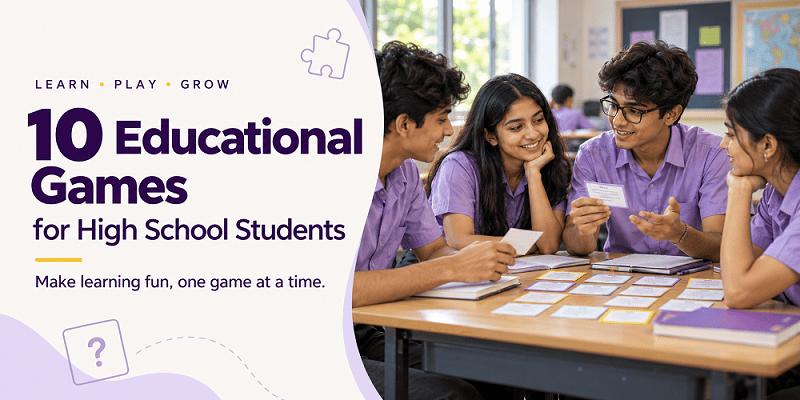
You’ve explained the concept, worked through an example, and asked a question. The same three hands go up. Everyone else suddenly finds something fascinating in their notebook.
A well-chosen game can change that pattern. It gives students a reason to retrieve information, test an idea, or explain their thinking to someone else. The challenge is choosing classroom games for students that offer enough substance for teenagers without feeling like another worksheet wearing a party hat.
These ten activities give you a practical starting point, with no expensive equipment required.
10 Games That Give Lessons a Clear Purpose
1. Spot the Mistake
Put an incorrect solution, paragraph, or labelled diagram on the board. Teams earn one point for identifying the mistake and another for explaining the correction.
In algebra, show a solution that mishandles a negative sign. In English, use a paragraph with inconsistent tense. Start with one deliberate error, then introduce subtler mistakes as students become confident.
Allow a challenge: students can question a correction if they support their argument.
2. Vocabulary Taboo
Write a subject term on a card, followed by three related words the speaker cannot use. Their teammates must guess the term from the explanation.
For “photosynthesis,” you might ban “plant,” “sunlight,” and “food.” That restriction pushes students beyond a memorised definition. Give each speaker a pass option so an unfamiliar term doesn’t stall the round.
3. Classroom Escape Challenge
Create three or four connected puzzles, each revealing information needed for the next. A history challenge might combine a timeline, a source extract, and a map.
Keep every puzzle connected to the lesson. A random riddle may be entertaining, but it won’t tell you much about students’ understanding of history.
Use envelopes instead of physical locks, and provide hints when groups get stuck.
4. Evidence Auction
Give teams an imaginary budget and several pieces of evidence connected to a claim. They bid on the evidence they believe will best support their argument.
For a geography lesson, offer rainfall records, an unattributed opinion, and dated photographs. After bidding, teams explain their purchases and identify weaknesses.
The interesting part comes when an expensive piece of evidence turns out to be less useful than expected.
5. Reverse Quiz
Instead of answering questions, students receive answers and write suitable questions.
If the answer is “mitochondrion,” a basic question might ask students to identify a cell structure. A stronger question could describe a cell’s energy needs and ask which organelle is relevant.
Award points for accuracy, clarity, and appropriate difficulty. This makes question writing part of the learning.
6. Concept Connection Cards
Prepare cards containing terms, examples, formulas, events, or quotations. Students draw two cards and explain a valid connection.
A biology pair might link “deforestation” with “biodiversity.” Literature students could connect a quotation with a theme.
Let classmates accept or challenge each explanation using subject knowledge. Avoid awarding points simply because an answer sounds confident.
7. Mini Budget Challenge
Give groups a fictional situation: organising a school exhibition with a fixed budget. Supply costs for materials, transport, publicity, and refreshments.
Halfway through, introduce a change, such as a supplier increasing prices. Teams revise their calculations and defend their choices.
This combines percentages, budgeting, and decision-making. Keep the scenarios fictional so nobody feels pressured to discuss their family’s finances.
8. Twenty Questions: Subject Edition
Choose a historical figure, chemical element, literary character, or mathematical shape. Students have twenty yes-or-no questions to identify it.
Encourage questions that narrow the possibilities: “Is it a metal?” is usually more useful than an early random guess.
After the round, discuss which questions helped most. Students can then try again with a more deliberate strategy.
9. Silent Team Timeline
Give each student an event card and ask the class to arrange themselves chronologically without speaking. For a seated version, teams arrange cards on a desk.
Once the order is fixed, students explain their decisions and correct errors together.
This works with historical events, stages of a scientific process, or plot developments. Provide written dates or visual clues when needed.
10. Question Ladder
Prepare questions at three levels: recall, application, and explanation. Teams choose a level, with more points available for harder tasks.
In physics, students might identify a formula, apply it, or explain why it fits a situation.
Require everyone to attempt an answer before teams agree. That small rule helps prevent one confident student from doing all the work.
Making the Games Work for Your Class
The best educational games for students begin with a specific goal. Decide what students should practise before choosing the format.
| Your lesson goal |
A useful game |
|
|
|
|
|
|
|
|
|
|
|
|
When planning games for high school students in the classroom, keep instructions brief and demonstrate one round. Rotate roles so quieter students can contribute through writing, organising, or checking answers.
Mistakes Worth Avoiding
Speed should not determine every winner. Give thinking time, reward explanations, and avoid elimination rounds that leave students watching.
Even fun classroom activities need a closing task. Ask each student to answer one question independently; team success can hide individual confusion.
Frequently Asked Questions
How long should a classroom game last?
Start with ten to fifteen minutes, including instructions and a short discussion. Extend it only when the task needs more time.
Can parents use these games at home?
Yes. Try Vocabulary Taboo with revision terms or Spot the Mistake with a worked example. Keep sessions short and let your teenager set questions too.
What should parents look for during school visits?
When comparing schools in Greater Noida West, ask how teachers connect activities to lesson goals and check individual understanding afterwards. A lively classroom is encouraging; purposeful participation matters more.
Give One Game a Trial Run
Choose a game that fits next week’s lesson, prepare a small set of materials, and check what students understood afterwards. Keep the parts that produce useful thinking, adjust what gets in the way, and build from there.