Is Your Child Ready for an AI-Powered World? What Every Parent Must Know
Apr 08, 2026
Imagine your child sitting in a classroom a decade from now — not just using technology, but designing it, questioning it, and leading with it. That future is arriving faster than most of us anticipated. And the schools that prepare children for it today are the ones that will define tomorrow's generation of innovators.
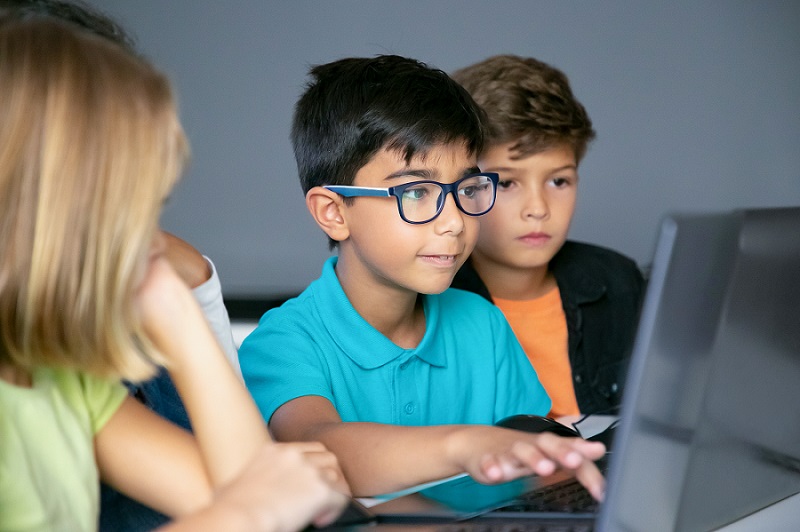
As a parent, you are likely already asking the most important questions: What skills will my child actually need? Is our school keeping up? And am I doing enough at home to help? If those questions feel urgent right now, they should — because 2026 marks a genuine turning point in Indian education.
This blog is written for you — not for policymakers or technologists, but for the parent sitting at the kitchen table wondering what "AI in education" really means for the eight-year-old doing homework across from you.
What is Happening Right Now in Indian Schools?
In October 2025, India's Ministry of Education made a landmark announcement: Artificial Intelligence and Computational Thinking (AI & CT) will be introduced in all schools from Class 3 onwards, beginning with the academic session 2026–27. This is not a pilot programme or an elective for a handful of students. It is a national curriculum overhaul aligned with the National Education Policy (NEP) 2020 and the National Curriculum Framework (NCF-SE) 2023.
What The Government has Announced
India plans to equip 21 million CBSE students with AI literacy, supporting the country's ambitious goal of creating 10 million AI-ready jobs by 2030. The curriculum rollout begins with Classes 3–8 in 2026–27, and extends to Classes 9–10 in 2027–28.
This is not India's first step in this direction. CBSE introduced AI as an optional subject for Class 9 students as far back as 2019, and currently offers a 15-hour AI skill module from Class 6 onwards. But the 2026 rollout is different in scale and intent. For the first time, AI thinking will be embedded into foundational education, reaching children as young as eight years old, not as a separate subject, but woven into how they learn to think and solve problems.
How the AI Curriculum Will Evolve Grade by Grade
Classes 3–5 · Ages 8–10
Curiosity & Computational Thinking
Children learn basic problem-solving, pattern recognition, and the concept of data — not through screens alone, but through activities and play-based learning that build logical thinking without requiring devices.
Classes 6–8 · Ages 11–13
Exploration & Interactive Projects
Students begin exploring how AI works — through hands-on projects, simple algorithms, and understanding AI's applications and its limitations in everyday life.
Classes 9–10 · Ages 14–15
AI as a Compulsory Subject
AI becomes a core part of the curriculum, with structured learning around real-world applications, ethical use, and data science fundamentals.
Classes 11–12 · Ages 16–17
Specialisation & Machine Learning
Students can choose AI as an elective specialisation, diving into machine learning algorithms and their real-world career applications across industries.
Why This Matters More Than Any Exam Score
As parents, it is natural to focus on marks, ranks, and admissions. But the World Economic Forum's Future of Jobs Report 2025 projects that 23–25% of roles globally will change significantly within five years and India's own NITI Aayog estimates that 35–40% of current jobs worldwide are susceptible to some level of AI-driven automation.
This does not mean your child's future is under threat. It means the skills that will protect and advance that future are changing. The children who will thrive are not necessarily those with the highest marks in traditional subjects. They are the ones who can think critically, adapt quickly, communicate clearly, and collaborate with both humans and machines.
"The goal is to transition students from being merely technology users to critical thinkers — young people who understand AI's possibilities and its limitations."
The good news? These skills are absolutely teachable. And the best schools are already building them — not by replacing traditional learning, but by enriching it.
The 6 Future-Ready Skills Your Child Needs Today
Whether your child is in Class 3 or Class 11, these are the capabilities that schools and parents should be actively nurturing right now.
1. Critical Thinking
Questioning information, spotting patterns, and evaluating AI outputs rather than blindly trusting them.
2. Computational Thinking
Breaking complex problems into manageable steps — the foundation of coding, AI, and logical reasoning.
3. Digital Literacy
Understanding data, privacy, online safety, and how to use AI tools responsibly and ethically.
4. Emotional Intelligence
Empathy, collaboration, and communication — the deeply human skills that AI simply cannot replicate.
5. Adaptability
The ability to learn, unlearn, and relearn as industries, tools, and job roles evolve continuously.
6. Data Reasoning
Reading graphs, questioning statistics, and making decisions based on evidence rather than assumptions.
How AI Is Already Changing What Happens in Classrooms
The image many parents have of "AI in school" is children staring at screens while robots teach lessons. The reality is far more thoughtful — and far more exciting.
Personalised Learning That Fits Each Child
AI-powered learning platforms can analyse a student's strengths, flag where they're struggling, and adapt content in real time. A child who finds fractions difficult gets more practice opportunities in a format that suits their learning style. A child who has mastered the concept moves on without waiting. This is not the future — progressive schools are implementing this today.
Teachers With More Time to Teach
One of AI's most underappreciated benefits in schools is the time it gives back to educators. Attendance tracking, internal assessment grading, and report generation — tasks that once consumed hours of a teacher's week — can be automated. This frees educators to focus on what they do best: mentoring, inspiring, and building relationships with students that no algorithm can replicate.
Instant, Meaningful Feedback
Traditional education involves a long feedback loop: a student submits work, a teacher grades it, and the student receives feedback days later. AI enables immediate insights, helping students understand where they went wrong while the concept is still fresh in their minds. For parents, this means your child is not waiting weeks to discover they've misunderstood a chapter.
Beyond Academics — Supporting the Whole Child
AI tools are also being used to support student wellbeing. From identifying early signs of learning difficulties to offering personalised counselling pathways, responsible schools are using technology not just to improve grades, but to protect the mental and emotional health of students during the most formative years of their lives.
A Word of Balance
The best educators are clear that AI is a tool, not a teacher. Human mentorship, creative exploration, social development, and ethical reasoning must remain at the heart of every child's education. Screens and algorithms enrich learning — they do not replace the irreplaceable human element of great schooling.
At JM International School, Greater Noida West
We Are Already Building Tomorrow's Learners
- Atal Tinkering Lab-style innovation spaces where students work on real-world problem-solving and computational thinking projects from the middle school years.
- Smart, audio-visual digital classrooms that integrate technology meaningfully — enhancing engagement without replacing human-centred teaching.
- An activity club structure that develops adaptability, leadership, and creative thinking through experiential learning across all age groups.
- Career guidance and counselling from Class 9 onwards, helping senior students navigate the AI-influenced landscape of college choices and future careers.
- Educator Empowerment Programme (EEP) ensuring our teachers are continuously trained in the latest pedagogical approaches — including AI-assisted teaching methods.
- Ranked No. 1 by Education Today 2023 and in the Top 3 Schools of Greater Noida West by Times School Survey 2025 — a reflection of our commitment to genuine excellence.
What You Can Do at Home: 7 Practical Ways to Raise a Future-Ready Child
Schools play a crucial role, but parents are a child's first and most lasting teachers. Here are concrete, actionable things you can start today — no tech expertise required.
-
Encourage "why" and "how" questions — not just "what"
When your child asks how Alexa knows the weather or why a YouTube recommendation appears, engage with the question. Curiosity about technology is the seed of computational thinking.
-
Make screen time purposeful, not passive
There is a significant difference between a child watching videos and a child using a coding app, creating a presentation, or editing a short film. Purposeful digital engagement builds real skills.
-
Introduce age-appropriate coding or logic games
Platforms like Scratch (for younger children) or simple robotics kits make computational thinking tangible and fun. Many libraries and school clubs offer access at no cost.
-
Talk about AI ethics around the dinner table
Ask your child: "Is it fair if an AI decides who gets a job?" These conversations build the ethical reasoning that the CBSE curriculum itself emphasises — and positions your child as a thoughtful future citizen.
-
Prioritise reading — it is more future-proof than ever
Strong reading comprehension, vocabulary, and the ability to write clearly are skills AI cannot replace — and are precisely what will make your child stand out in an AI-saturated world.
-
Let them fail — and figure it out
Adaptability is the most future-proof skill of all. Children who learn to handle setbacks, try new approaches, and persist through difficulty will be more resilient in a world that changes every few years.
-
Stay connected with your child's school
Ask your child's teachers how they are integrating technology. Attend parent engagement sessions. The partnership between a school and a family is still — and will always be — the most powerful educational tool available.
The Reassurance Every Parent Needs to Hear
It would be easy to read everything above and feel overwhelmed — as though the world is changing so fast that childhood itself is at risk of being swallowed by algorithms and screens.
Here is the truth: the fundamentals of a great education have not changed. Children still need to feel safe, seen, and encouraged. They still need to read stories and get muddy on a sports field and make friends and fail at things and try again. They still need a teacher who believes in them on the days they don't believe in themselves.
What AI changes is not the heart of education — it changes the tools and the landscape around it. The schools doing this well are the ones that understand the difference: using technology to enhance human potential, not replace it.
"The question is not whether AI will be part of your child's future. It will. The question is whether your child is in a school that is preparing them for that future with wisdom, warmth, and genuine care."
At JM International School, Greater Noida West, we believe that future-ready education is not about loading children with technology. It is about building the confidence, curiosity, and character to use technology wisely. That has always been our purpose. It is why families across Greater Noida West choose us, and it is the commitment we make to every child who walks through our doors.